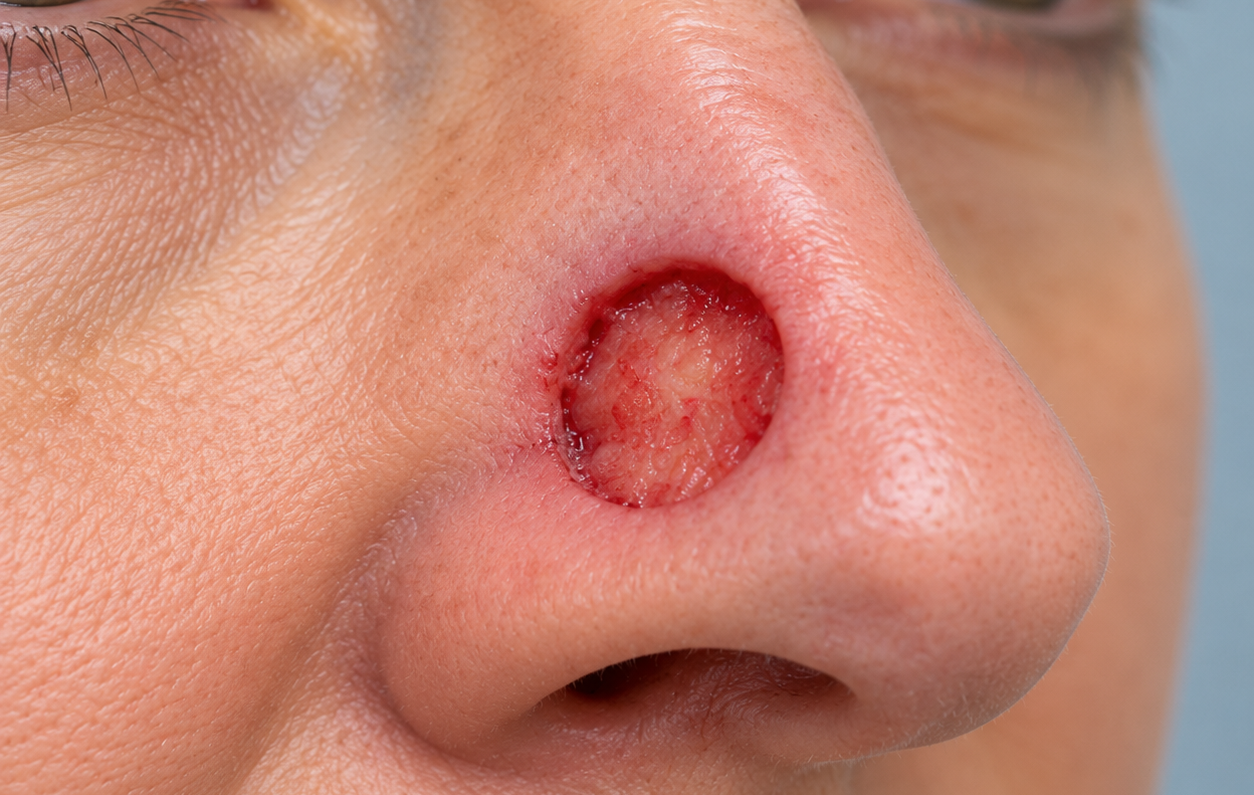
After Mohs surgery on the nose, the wound may be repaired with stitches, a skin graft or a skin flap. Some carefully selected wounds can heal without reconstructive surgery. The choice depends on the wound’s size, depth and position; together with the surrounding tissue and your individual circumstances.
For many patients, the most worrying question is straightforward: “What will my nose look like afterwards?”
It’s understandable to feel anxious about surgery in the centre of your face. But knowing how cancer removal and reconstruction fit together can make the process easier to understand.
Are Mohs surgery and reconstruction the same thing?
They are related parts of treatment, but they have different purposes.
Mohs surgery removes skin cancer while the tissue margins are examined under a microscope. Further tissue is removed where necessary until the treating team confirms clearance. Reconstruction addresses the wound that remains.
Mohs surgery is normally performed by a dermatologist with specialist training. Depending on the repair needed, another surgeon may undertake reconstruction. The British Association of Dermatologists specifically identifies maxillofacial surgeons among the specialists who may perform this role.
In collaborative cases involving Mr Ross Elledge, dermatology colleagues perform the Mohs procedure and his role is to reconstruct the resulting facial defect.
Why can the wound be larger than the original spot?
The visible surface does not always show the full extent of a skin cancer. Some tumours have poorly defined edges or extend beyond what can be seen.
This means the final wound may be larger than the original mark suggested. It does not automatically mean something has gone wrong. Removing the affected tissue takes priority, while preserving healthy tissue wherever possible.
An initial reconstruction plan may therefore need to be adjusted after the cancer has been removed. The extent of the tumour can be difficult to predict before treatment.
Why not simply stitch the wound closed?
Sometimes direct closure with stitches is appropriate. However, the nose has limited spare skin, and pulling a wound together under tension may distort its shape.
The location matters as much as the diameter. A wound beside the nostril presents different challenges from one higher on the bridge. Reconstruction must consider the outline of the nose and nearby structures, as well as covering the missing skin.
The aim is a repair suited to the defect, rather than choosing the smallest-sounding procedure.
What is the difference between a skin graft and a skin flap?
- A skin graft is skin taken from another part of the body and transferred to the wound. It becomes established by developing a blood supply from the area beneath it. There is also a donor site to care for.
- A skin flap moves tissue into the wound while maintaining an attached blood supply. A local flap uses nearby tissue, which may offer a useful match in colour and thickness.
Neither method is universally better. The wound, available tissue and reconstructive priorities determine which option is suitable.
Why might a forehead flap be recommended?
Some nasal wounds are difficult to repair using a graft or smaller local flap. A forehead flap brings skin from the forehead to the nose while maintaining its blood supply through a temporary connecting section.
This is a staged reconstruction. The connection remains while the transferred tissue establishes itself, and a later operation separates it. Additional refinement may sometimes be needed.
The temporary appearance can be confronting, so understanding the stages beforehand is important. The number of operations and intervals between them depend on the individual reconstruction; they should not be assumed from another patient’s photographs.
Is reconstruction performed on the same day?
It may be, but this is not guaranteed.
Some repairs take place immediately after clearance, while others are arranged for a later date with another surgical team. If there is an interval, you should receive a dressing, wound-care instructions and clear information about the next appointment.
What should you ask before treatment?
Useful questions include:
- Who will remove the cancer, and who will reconstruct the wound?
- Which repairs are likely, and what could change that plan?
- Will treatment involve one operation or several?
- What anaesthetic is expected?
- How will the dressings and stitches be managed?
- What support will I need at home?
- Who should I contact if I have concerns?
Reconstruction leaves scars, and no surgeon can promise an invisible result. Potential complications include bleeding, infection and problems with graft or flap healing. Your surgeon should explain the risks relevant to your proposed procedure.
Facial reconstruction with Mr Ross Elledge
Mr Ross Elledge’s work includes facial reconstruction following skin cancer removal, working with colleagues where specialist Mohs surgery is required.
For patients seeking advice in Birmingham and the West Midlands, a consultation offers an opportunity to understand the likely repair, its stages and the support needed during recovery.
Learn more about facial skin cancer care at Elledge Surgical or contact the practice about reconstructive assessment.