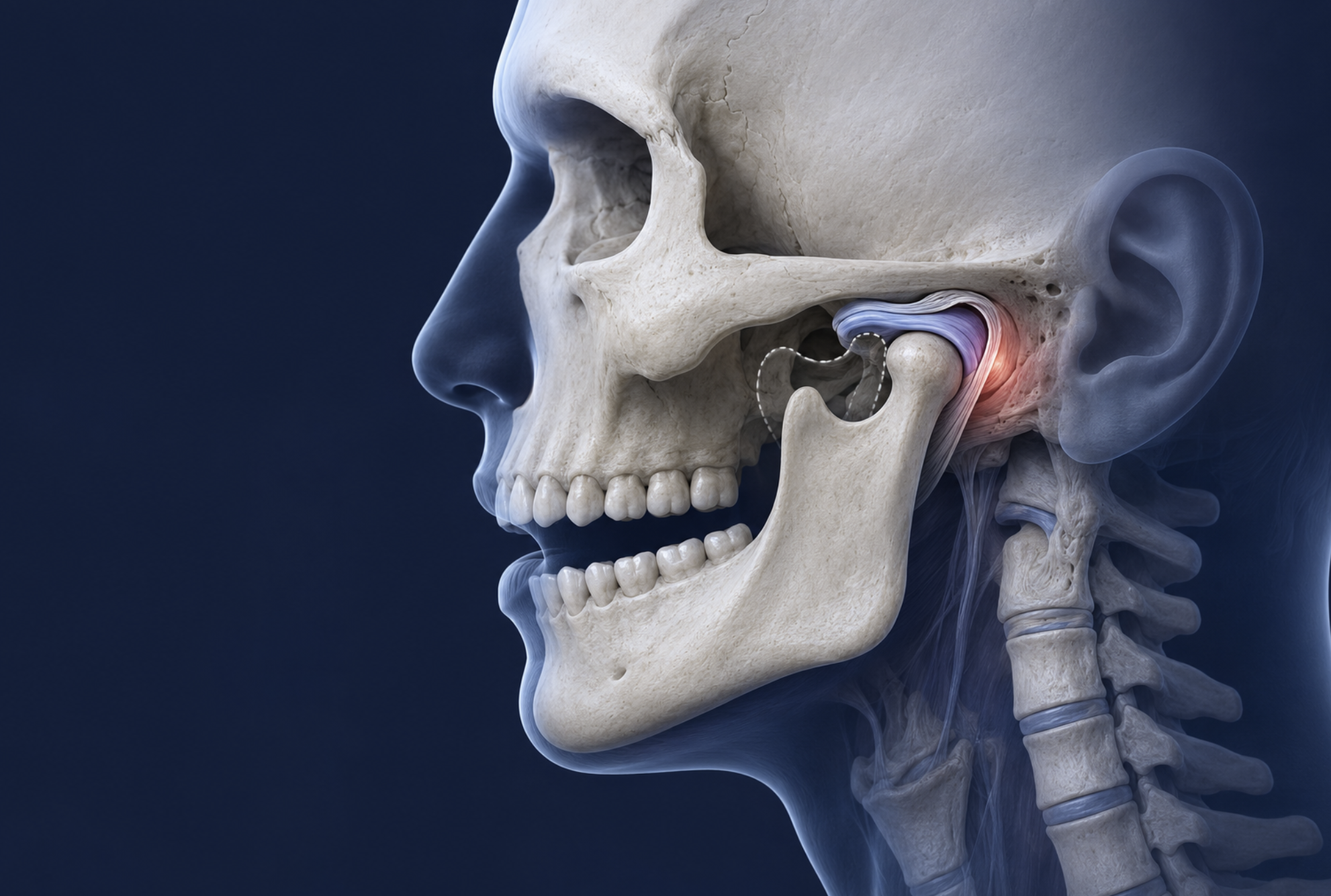
A jaw that suddenly feels stuck can be uncomfortable and alarming. You may find that your jaw doesn’t open fully, keeps locking on one side or catches before releasing with a click. Some people can still eat with care, while others struggle to fit more than one or two fingers between their front teeth.
A locked jaw can have several causes, so it is important not to assume that every case is the same.
What does a locked jaw mean?
The jaw joints – known as the temporomandibular joints or TMJs – connect the lower jaw to the skull. A small cartilage disc inside each joint helps the jaw move smoothly.
In some patients, this disc moves out of its usual position. It may initially produce clicking as the disc slips out and then returns during movement. But if it no longer returns to its normal position, it can obstruct the forward movement needed to open the mouth fully. This is often described as a closed lock or disc displacement without reduction.
Not every restricted jaw is caused by the disc. Limited opening may also result from:
- Spasm or inflammation of the jaw muscles
- Arthritis within the TMJ
- Recent dental treatment requiring prolonged mouth opening
- Injury to the jaw or face
- Infection, including problems involving a wisdom tooth
- Scarring, joint fusion or another less common structural condition
Will my clicking jaw lock?
A painless click is common and does not necessarily require treatment. Many people have a clicking jaw for years without it progressing.
A click becomes more relevant when it is accompanied by pain, intermittent catching or gradually reduced movement. If a jaw that previously clicked suddenly stops clicking and becomes difficult to open, the disc may no longer be returning to position.
However, symptoms alone cannot confirm the diagnosis. A careful history and examination are required.
What should I do if my jaw locks?
Do not repeatedly force or violently manipulate your jaw. This can aggravate pain and inflammation.
While awaiting advice, it may help to:
- Choose soft foods that require little chewing
- Avoid chewing gum and very chewy foods
- Avoid opening particularly wide
- Support the jaw when yawning
- Apply gentle warmth if it feels soothing
- Use pain relief that is safe for you
These measures do not replace an assessment, especially if the restriction persists. NHS advice on temporomandibular disorders recommends seeking urgent advice when jaw locking or difficulty opening affects eating or drinking.
If your mouth is stuck open and cannot close, this may represent a dislocation and requires urgent medical attention. You should also obtain urgent help following significant trauma, or if there is marked swelling, fever, difficulty swallowing or difficulty breathing.
How is a locked jaw treated?
Treatment depends on the underlying cause, severity and duration.
Many TMJ problems improve with conservative care such as temporary dietary modification, physiotherapy, medication and management of clenching or grinding. Surgery is not the starting point for most patients.
When there is persistent joint-related locking that does not respond to appropriate conservative measures, treatment may include an injection, arthrocentesis or TMJ arthroscopy. Arthroscopy is a minimally invasive procedure that allows the joint to be examined and treated through very small entry points.
Open surgery is reserved for carefully selected cases with significant structural disease. A responsible TMJ specialist should explain the diagnosis, non-surgical alternatives, expected benefits and risks before recommending any procedure.
When should I see a TMJ specialist?
Consider specialist assessment if:
- Your jaw remains locked or repeatedly catches
- Your mouth opening is progressively reducing
- Pain or restriction is affecting eating
- Symptoms persist despite initial treatment
- You have arthritis or a history of jaw trauma
- The diagnosis remains uncertain
- You would like a second opinion before surgery
Mr Ross Elledge is a Consultant Oral and Maxillofacial Surgeon with a subspecialist practice in TMJ assessment and surgery; including minimally invasive arthroscopy, open arthroplasty and custom total joint replacement.
An appointment can establish whether the problem lies within the joint, the surrounding muscles or another structure – and whether treatment is required at all.
If this sounds like you, get in touch to find out more.